01Why chef whites are white
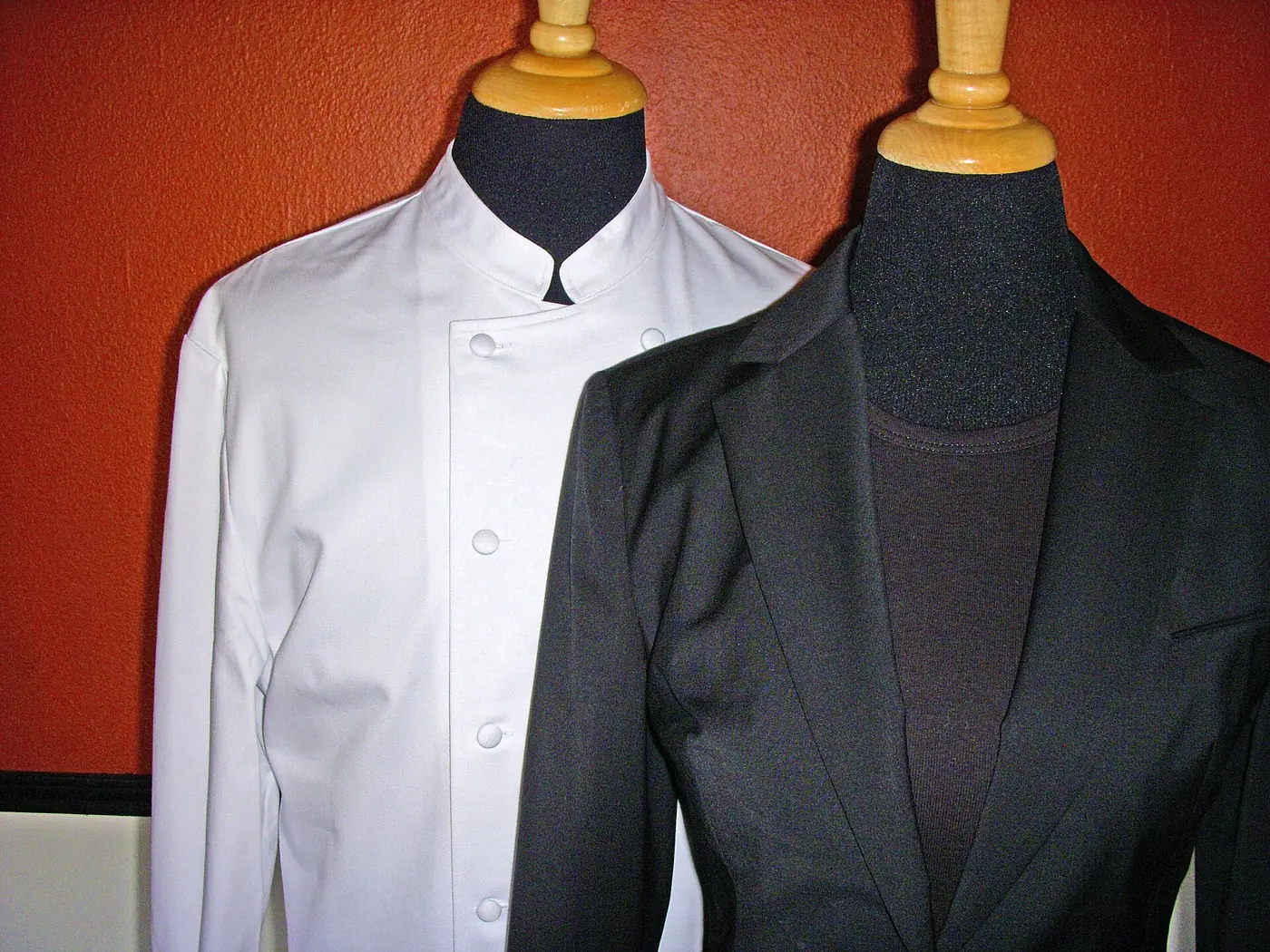
The white chef jacket is one of the most recognisable work uniforms in the world. Its colour is not just tradition. White shows dirt immediately, so a cook in a clean white jacket is visibly clean, and a cook in a stained one knows it is time to change. White can be washed hot and treated firmly, which matters for a garment that spends all day near raw meat, fish, dairy and heat. And white reflects some heat, which helps in a hot kitchen.
The design carries practical thinking too. The classic double-breasted jacket can be rebuttoned the other way to hide a spill during service. Long sleeves protect arms from splashes and steam. Thick cotton or polycotton gives a little protection against heat and spitting oil. The trousers, often in a check or a dark colour, hide marks on the part of the uniform that takes the most splashes from below.
All of that only works if the whites are actually clean. A grey, yellowed or stained jacket undermines the point of wearing white at all, and in an open kitchen, guests notice. Inspectors notice too. Keeping whites properly white is part of running a professional kitchen.
What this guide covers
This guide covers how often whites should be changed, how many sets each cook needs, what stains appear and how to deal with them, how whites should be washed, dried and pressed, how to store them, and when to replace them. It also covers aprons, trousers, hats and neckerchiefs, and the question of whether cooks should wash their own whites at home.
02How often to change chef whites
There is no single rule that suits every kitchen, but the principle is simple: whites should be clean at the start of every shift and changed whenever they become visibly soiled or contaminated.
| Item | Typical change frequency | Change sooner if |
|---|---|---|
| Jacket | Every shift | Splashed with raw meat juices, heavily soiled, wet through |
| Apron | Every shift, often more than once | Wet, heavily stained, after raw meat or fish work |
| Trousers | Every shift or every other shift | Visibly soiled or splashed |
| Neckerchief or skull cap | Every shift | Sweat-soaked |
| Side towel or oven cloth | Several times a shift | Damp, greasy or used on raw food |
Split shifts
In kitchens with split shifts, many cooks change into a fresh jacket for evening service, especially in open kitchens. A jacket that has been through a hot lunch service rarely looks fresh by dinner.
Raw food and changing
After handling raw meat, poultry or fish, a cook whose apron or jacket has been splashed should change before moving on to ready-to-eat food. Aprons are the main barrier here and should be changed freely.
03How many sets each cook needs
If whites are changed every shift and sent to a laundry, each cook needs enough sets to cover the days between collection and return, plus a spare.
| Item | Typical sets per cook | Notes |
|---|---|---|
| Jackets | 4–5 | More for split shifts or open kitchens |
| Trousers | 3–4 | Changed slightly less often |
| Aprons | 6–10 | Changed most often |
| Neckerchiefs or caps | 4–5 | Cheap but easy to lose |
A simple calculation
Count how many shifts a cook works between the laundry collecting whites and returning them clean. Add one set for the shift in progress and one spare for spills. For a cook working five shifts a week, with collections twice a week and a two-day return, that often comes to four or five jackets and a similar number of aprons.
Shared stock or personal sets
Some kitchens give each cook their own named whites; others keep a shared stock in sizes. Named whites fit better and cooks take more care of them, but sets are lost when staff leave. Shared stock is easier to manage and count, but sizes run out. Many kitchens use named jackets and shared aprons.
04The stains chef whites collect
Chef whites face every food stain there is, often in combination, and usually at high temperatures that set them faster.
| Stain | Family | Notes |
|---|---|---|
| Butter, oil, fat from frying | Grease | Spreads and greys if not lifted |
| Blood from meat and fish | Protein | Never hot water first |
| Egg, dairy, cream | Protein | Sets with heat |
| Tomato, beetroot, berries | Pigment | Strong colour, often with oil |
| Turmeric, saffron, paprika | Pigment | Very stubborn on cotton |
| Red wine and jus | Tannin and pigment | Darkens as it dries |
| Coffee | Tannin | Common at the start of a shift |
| Sweat | Protein and salts | Yellow at collar and underarms |
| Chocolate and caramel | Fat, sugar, pigment | Sticky, browns with heat |
Why kitchen stains set fast
In a kitchen, a splash often lands on a jacket that is already warm from the stoves. Then the cook works for hours more in that heat, and the jacket may sit in a warm locker or bag overnight. Heat is what sets protein and sugar stains and drives oil deeper. That is why chef whites can look worse than any other linen.
Sweat and collars
Kitchens are hot, and cooks sweat. The collar, cuffs and underarms of jackets build up sweat and body oils, which turn yellow over time. These areas need attention in every wash, not just when they visibly discolour.
05At the end of the shift
How whites are treated in the half hour after a shift has a large effect on how they come out of the wash.
- Take whites off as soon as the shift ends rather than wearing them home.
- Empty pockets: thermometers, pens, lighters, tasting spoons and notes.
- Remove stud buttons and any detachable badges if your jackets use them.
- Put whites in the kitchen's whites bag, never with kitchen cloths or front-of-house linen.
- Put heavily stained items in a separate bag and note what caused the stains.
- Do not leave wet or heavily soiled whites in a sealed bag in a warm place.
Pockets
Pens are the classic disaster. A single biro left in a pocket can ruin an entire load of white jackets with ink. Thermometers, lighters and tasting spoons can damage machines and fabric. A pocket check at the end of every shift should be automatic.
Stud buttons
Many chef jackets use removable stud buttons, which pop through button holes and are held with a ring at the back. They can break or damage other items in the machine, and they are easily lost. Remove them before bagging and keep them in a small pot in the locker.
06Washing chef whites
Chef whites need a firm wash that removes heavy food soils and gives confidence on hygiene, without destroying the fabric.
Separate loads
Whites should be washed only with other whites from the kitchen. Never mix them with coloured items, front-of-house linen, kitchen cleaning cloths or staff's own clothes. Coloured trousers and aprons should be washed separately from white jackets.
Temperature
Many chef jackets are made of polycotton or cotton and are labelled for hot washing. Washing at the highest temperature the label allows helps remove fats and gives hygiene reassurance. Some lightweight or specialist jackets have lower limits, so always check.
Pre-treatment
Heavily stained areas, collars and cuffs benefit from pre-treatment before the main wash. Grease needs a product that breaks down fat; protein stains such as blood and egg need cold treatment first; pigments such as turmeric need specialist attention.
Detergent and rinsing
Kitchen soil is heavy, so the detergent dose needs to match. Too little and fats are redeposited, greying the whites; too much and residue builds up. Thorough rinsing is essential.
07Drying and pressing
A clean jacket that comes out of the dryer creased or limp does not look clean. Drying and pressing finish the job.
Drying
Tumble dry at a moderate heat, or as the label allows, until fully dry. Over-drying makes polycotton shiny and can yellow it slightly. Under-drying leaves jackets damp at the seams and collar, which leads to smells.
Pressing
Pressed jackets look sharp and professional, especially in open kitchens. Collars and front panels matter most. If jackets are not pressed, hanging them straight from the dryer while still warm reduces creasing considerably.
Hanging versus folding
Pressed jackets travel and store best on hangers. Folded jackets crease at the folds. If space allows, return and store jackets hung.
08Aprons
Aprons are the front line. They take more splashes than jackets and are changed more often.
Bib and waist aprons
Bib aprons protect the jacket's front and are standard in many kitchens. Waist aprons are lighter and popular for pastry, front-of-house cooks and bars. Both need the same care: frequent changes and separate washing.
Coloured aprons
Many kitchens use coloured or striped aprons, sometimes colour-coded by section or for raw meat. Coloured aprons must be washed separately from white jackets.
Ties and straps
Apron ties tangle in machines and wrap around other items. Tying them loosely before bagging, or using aprons with buckles or adjustable straps, reduces tangling and torn ties.
09Trousers, hats and neckerchiefs
The rest of the uniform needs care too, though it takes slightly less punishment than jackets and aprons.
Trousers
Chef trousers, often black, check or pinstripe, hide marks well, which is exactly why they can go too long between washes. Change them regularly, wash them separately from whites, and check the waistband and knees for wear.
Skull caps and hats
Hats and skull caps absorb sweat from the forehead. They should be washed after every shift. Paper hats are disposable; fabric ones need the same separate washing as whites.
Neckerchiefs
Neckerchiefs soak up sweat and are small enough to get lost. Wash them in mesh bags with whites.
10Washing at home or using a laundry
In many kitchens, cooks take their whites home to wash. It is convenient for the restaurant but has drawbacks.
Hygiene
Home washing often means lower temperatures, mixed loads with family clothes and less effective drying. Whites washed this way may look clean but carry fats and odours. They also travel on public transport and through homes before and after the shift.
Consistency
A kitchen where every cook washes differently will have whites in every shade from bright white to grey. In an open kitchen, the difference shows.
Using a laundry
A laundry washes all whites the same way, at suitable temperatures, with pre-treatment, and returns them pressed. It also means the kitchen controls stock and can see when whites need replacing.
11Storing clean whites
Clean whites need somewhere clean to wait.
- Store clean whites in a dedicated cupboard or on a rail, away from kitchen steam and food.
- Keep clean and used whites apart at all times.
- Give each cook a hook or locker space for the current shift's spare.
- Do not store whites in the same locker as outdoor shoes and coats.
- Use the oldest clean stock first.
12Choosing fabric and fit
When buying chef whites, choose for comfort, safety and washability.
Fabric
Polycotton jackets are durable, crease less and dry faster. Pure cotton is more breathable and comfortable in heat but creases more and may shrink. Lightweight jackets with breathable panels are popular in hot kitchens; check that they can be washed at the temperature you need.
Fit
Jackets should allow movement without being loose enough to catch on handles or flames. Sleeves should cover the arms fully. Trousers should be comfortable for long hours standing and bending.
Safety
Long sleeves and a double-breasted front offer protection from splashes and heat. Avoid synthetic fabrics that melt easily near open flames.
13When to replace whites
Whites wear out with frequent hot washing and heavy use. Replace them when they no longer do their job.
| Sign | What it means |
|---|---|
| Grey or yellow that does not wash out | Fabric holding soil; looks unclean |
| Permanent stains on the front | Unprofessional in open kitchens |
| Thin fabric at elbows or front | Less protection from splashes and heat |
| Frayed cuffs and collars | Looks worn; can catch |
| Broken button holes or seams | Can come open at the stove |
| Poor fit after shrinking | Restricts movement |
Budgeting for replacement
Plan replacement as a regular cost, perhaps once or twice a year for each cook's sets, depending on quality and use. Waiting until every jacket is worn out at once leads to a large expense and a scruffy kitchen in the meantime.
14Side towels and oven cloths
Every cook tucks a side towel into their apron string. It is used to grab hot pans, wipe plate rims, dry hands and occasionally mop a spill. It is one of the hardest-worked pieces of fabric in the building.
Dry, always
A side towel only protects from heat when it is dry. A damp towel conducts heat straight through to the hand, which is how many kitchen burns happen. Cooks should change side towels as soon as they become damp, and there should be a plentiful supply at every station.
Not for food surfaces
A side towel that has wiped raw meat juice or a dirty surface should not then be used on plate rims. Many kitchens use different colours for side towels and for cleaning cloths so the two are never confused.
Washing side towels
Side towels are heavily soiled with fat and food and must be washed separately from whites and from front-of-house linen. They need a firm wash and full drying. Because they are cheap and used in large numbers, they also go missing in large numbers; counting them is worthwhile.
15Pastry and bakery whites
Pastry kitchens and bakeries have their own stain profile. Flour, sugar, chocolate, caramel, fruit purées, food colourings and butter are the main culprits.
Flour and sugar
Flour dust clings to jackets and aprons. On its own it washes out easily, but mixed with water or butter it forms a paste that can cake in seams and pockets. Brush off loose flour before bagging. Sugar and caramel become sticky and can brown in a hot dryer if not fully washed out.
Food colouring
Concentrated food colourings, especially reds, blues and blacks, can stain whites badly. Aprons used for colouring work should be kept apart and noted as stained.
Chocolate
Tempered chocolate splashes combine fat, sugar and pigment. Scrape off any solid chocolate before bagging and treat as both a grease and a pigment stain.
16Whites in open kitchens
In an open kitchen, the cooks are part of the dining room's view. Guests watch the pass, see the cooks' faces and see their whites. A team in bright, pressed jackets looks professional and confident. A team in mixed shades of grey, with stains down the front, looks like the opposite.
Standards for open kitchens
- Fresh jacket at the start of every service, not just every day.
- Apron changes between raw preparation and plating.
- Matching whites for the whole team: same style, same colour, same condition.
- Spare jackets at hand for mid-service changes after a splash.
- Pressed jackets, not just tumble dried.
The double-breasted trick
The classic double-breasted jacket lets a cook rebutton the front the other way, putting the clean inner panel on the outside. It is a useful emergency measure during service, but not a substitute for a fresh jacket at the next opportunity.
17Whites and hygiene inspections
Food hygiene inspections look at many things, and the condition of staff clothing is part of the picture. Inspectors expect food handlers to wear clean clothing suitable for their work and to protect food from contamination.
What inspectors notice
Visibly dirty jackets and aprons, outdoor clothes worn in food areas, whites stored next to outdoor coats or in toilets, and cooks wearing whites outside the building are all things that can raise questions.
Simple good practice
- Clean whites put on at work, not travelled in.
- A clear system for clean and used whites.
- Enough spare whites for changes during service.
- Aprons changed after raw food work.
- Whites not worn outside for smoking breaks or deliveries.
Records
Some kitchens keep a simple log of whites issued and laundry collections. It is not usually required, but it shows that the system is managed.
18Allergens and cross-contact
Whites and aprons pick up food residues, including allergens such as nuts, sesame, gluten, dairy, egg, fish and shellfish. A cook who has been preparing a nut-based sauce and then moves to an allergen-free order is relying on clean hands, clean equipment and clean clothing.
Practical steps
- Change aprons between preparation of allergen-heavy dishes and allergen-free orders.
- Keep spare aprons at stations where allergen-free dishes are made.
- Wash whites thoroughly at a suitable temperature with a proper detergent, which removes food residues.
- Never reuse an apron or side towel from a raw or allergen-heavy task for plating.
Laundry and allergens
Washing removes food residues, but used whites should still be handled as soiled items and kept apart from clean whites until washed.
19Issuing whites to new starters
Kitchens have high staff turnover, and how whites are issued to new starters affects both stock and standards.
- Keep a range of sizes in reserve so a new cook can be fitted on day one.
- Issue a counted number of jackets, trousers and aprons and record it.
- Explain the changing, bagging and pocket-checking routine on the first shift.
- Show where clean whites are stored and where used whites go.
- Ask for whites to be returned when a cook leaves, and record what comes back.
Leavers
Many whites are lost when staff leave and take their sets with them. A simple sign-out and return record, and a friendly reminder on the last shift, recovers most of them.
20The chef whites checklist
- Change jackets and aprons every shift, and sooner after raw food or heavy soiling.
- Give each cook enough sets to cover the laundry cycle plus a spare.
- Empty pockets and remove stud buttons before bagging.
- Keep whites separate from coloured items, kitchen cloths and front-of-house linen.
- Separate heavily stained items and note the stains.
- Wash at the highest temperature the label allows, with pre-treatment.
- Dry fully without over-drying; press or hang warm.
- Store clean whites away from steam, food and outdoor clothes.
- Replace whites before they look grey or thin.
How ArkLaundry helps
Chef whites are washed apart from coloured linen, marks are treated first, and jackets come back pressed. Jackets from your own stock are £2.20, trousers £1.80, excluding VAT.