01What dry cleaning actually is
The name is misleading. Dry cleaning is not dry at all. Garments go into a machine that looks a lot like a large front-loading washing machine, and they are cleaned in liquid. The difference is that the liquid is not water. It is a solvent, a cleaning fluid that dissolves oils and grease very effectively but does not soak into fibres the way water does.
That difference matters. Water makes many natural fibres swell. Wool fibres swell and their surface scales lock together when agitated, causing shrinking and felting. Silk can lose its sheen and show water marks. Viscose becomes weak and can shrink or distort. Tailored garments with layers of interfacing, padding and lining can pucker, bubble and lose shape when soaked. A solvent avoids most of this, cleaning the garment without the swelling and distortion that water causes.
After cleaning, the solvent is removed and recovered, the garment is dried in the machine and then finished: pressed, steamed or shaped on forms so it looks as it should. Before cleaning, a good dry cleaner inspects the garment and treats stains, a process often called spotting.
Wet cleaning
Many professional cleaners also offer wet cleaning: a carefully controlled water-based process using special machines, detergents and finishing equipment. It can clean some garments labelled for dry cleaning, and the care label may show a separate symbol for it.
02What happens to a garment at the dry cleaner
Understanding the process helps you know what to expect.
When you hand in a garment, it is tagged so it can be tracked. It is inspected for stains, damage, loose buttons and anything left in pockets. Stains are pre-treated with products chosen for the type of stain and fabric. The garment is then cleaned in a machine with solvent, which is filtered and recovered. After cleaning and drying, any remaining marks are treated again where possible.
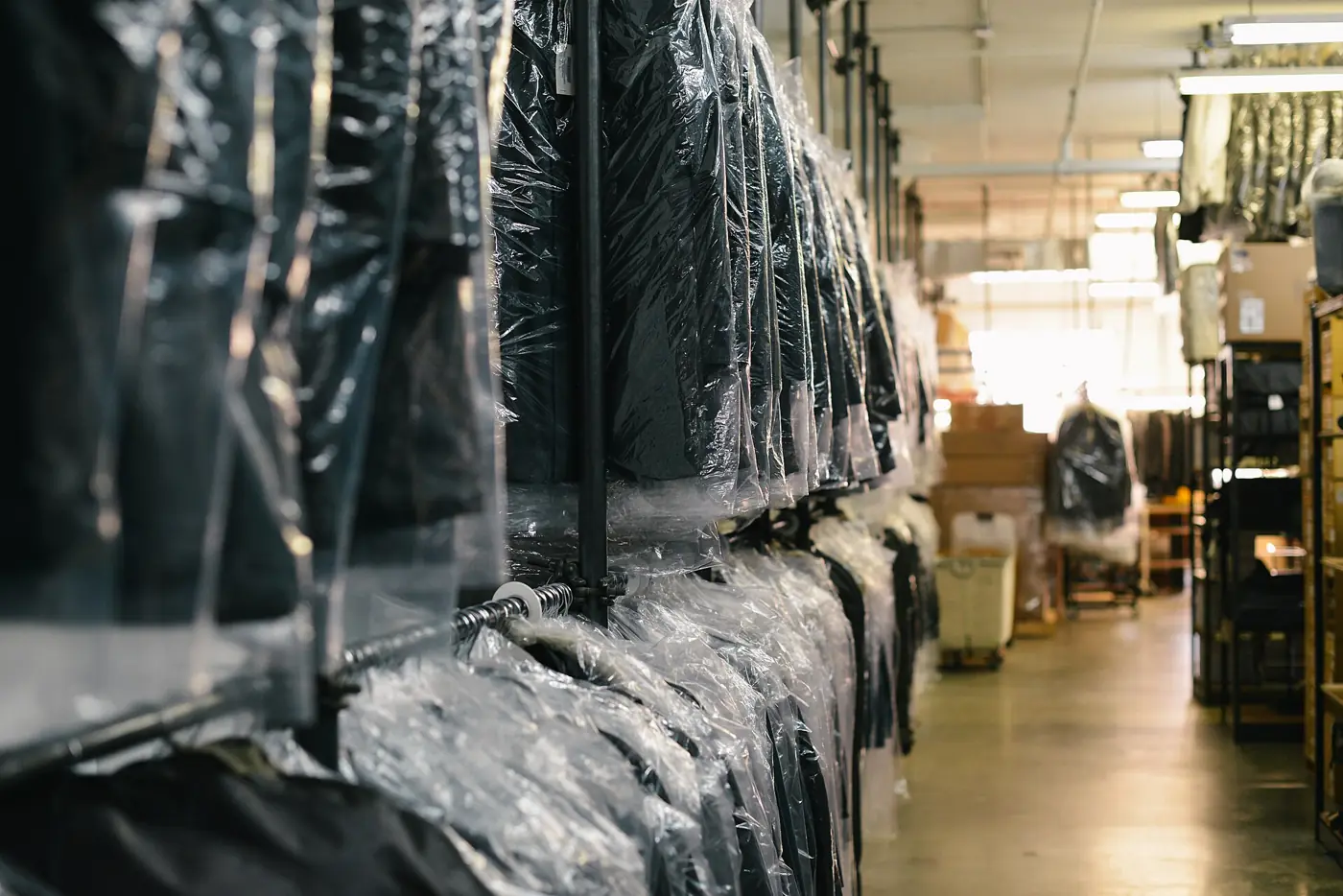
Finishing comes next, and it is what makes a garment look professionally cleaned. Jackets are pressed on shaped forms that steam and support them. Trousers are pressed with sharp creases. Shirts and blouses are pressed on presses or by hand. Delicate garments are steamed and shaped. Finally, the garment is inspected, put on a hanger and covered.
Each step needs skill and judgement, which is why the condition of a garment after dry cleaning depends so much on who does it.
03Solvents in plain words
Different cleaners use different solvents, and the care label sometimes specifies which are suitable.
Some solvents are very effective at removing oils and have been used for decades. Others, such as hydrocarbon solvents, are gentler on some fabrics and trims. Newer alternatives have been developed in response to environmental concerns. You do not need to know the chemistry; what matters is that the cleaner chooses a process the care label allows.
If you have sensitivities or environmental preferences, ask your cleaner which processes they use, and whether wet cleaning is available for suitable garments.
04Professional wet cleaning in more detail
Professional wet cleaning is different from washing at home, even though both use water. Wet cleaning machines control the drum's movement very precisely, often with far less agitation than a home machine. They use special detergents and conditioners designed to protect fibres from swelling and shrinking, and they monitor temperature closely. Drying is equally controlled, often with moisture sensors that stop before fibres are over-dried. Finishing equipment, such as tensioning forms for jackets and trousers, gently stretches garments back to their correct size and shape while they are steamed and dried.
Because of that control, wet cleaning can safely clean many garments that would be ruined in a domestic machine, including some wool tailoring and silk. It is also very good at removing water-based stains such as sweat, food and drinks. Whether it is suitable depends on the garment and its label; a care label with a W in a circle shows that professional wet cleaning is allowed. Ask your cleaner whether they offer it and which of your garments would suit it.
05Reading the care label
The care label is the first and most reliable guide. It reflects the manufacturer's testing of the whole garment, including linings, trims and interfacing, not just the outer fabric.
| Symbol | Meaning |
|---|---|
| Circle | Can be professionally dry cleaned |
| Circle with letter P | Dry clean with common solvents |
| Circle with letter F | Dry clean with hydrocarbon solvents only |
| Circle with letter W | Professional wet cleaning |
| Line under the circle | Gentle professional process |
| Crossed-out circle | Do not dry clean |
| Washtub with a number | Machine washable to that temperature |
| Washtub with a hand | Hand wash only |
| Crossed-out washtub | Do not wash |
"Dry clean" versus "dry clean only"
A label showing a circle but also a washtub means both are possible. A label that says "dry clean only", or shows a crossed-out washtub, means the maker does not consider washing safe. Many people wash "dry clean" garments successfully, but washing a "dry clean only" item is a genuine risk.
06Garments that usually need dry cleaning
Some garments almost always belong at the dry cleaner, whatever the fabric.
- Tailored suits and structured jackets, because of their internal construction.
- Wool coats, especially heavy or lined ones.
- Silk dresses, blouses and ties.
- Evening wear, beaded and embellished garments.
- Garments with leather, suede or fur trims.
- Pleated garments where pleats are pressed rather than permanent.
- Items with dyes that run in water.
- Velvet, taffeta, brocade and many special fabrics.
Why structure matters
A tailored jacket might look like simple wool on the outside, but inside are layers of canvas or fused interfacing, shoulder padding, pocket linings and a full lining. Each layer reacts to water differently. Washing can shrink one layer more than another, causing puckering, bubbles and a collapsed shape that pressing cannot fully fix.
07Garments that can usually be washed
Many garments people take to the dry cleaner could be washed at home, if the label allows.
- Cotton and linen shirts, trousers and dresses.
- Polyester and many blended garments.
- Machine-washable wool and cashmere knitwear, on a wool cycle or by hand.
- Many unlined, unstructured casual jackets.
- Most everyday casual wear.
Always check the label first. "Machine washable" wool has been treated to resist felting; untreated wool has not.
08Fabric by fabric
| Fabric | Usually | Notes |
|---|---|---|
| Cotton | Wash | Unless tailored or labelled otherwise |
| Linen | Wash or dry clean | Structured linen suits often need dry cleaning |
| Wool | Depends | Knits may be washable; tailoring and coats usually dry clean |
| Cashmere | Hand wash or dry clean | Follow label |
| Silk | Dry clean or careful hand wash | Some silk is labelled washable; much is not |
| Viscose | Often dry clean or gentle hand wash | Weak when wet; can shrink |
| Polyester | Wash | Unless structured or embellished |
| Acetate | Dry clean | Sensitive to water and heat |
| Velvet | Dry clean | Pile crushes easily |
| Leather and suede | Specialist cleaning | Not standard dry cleaning |
09What can go wrong if you wash a dry-clean-only item
People often wash dry-clean-only garments to save money. Sometimes it works; sometimes the result is a garment that cannot be saved.
Wool can shrink and felt, becoming smaller, thicker and stiffer. Silk can lose its sheen, show water rings or change colour. Viscose can shrink dramatically or become misshapen. Structured jackets can pucker as interfacing separates from the outer fabric, and shoulder pads can lump. Dyes can run, especially in printed silks and deep colours. Linings can shrink more than the outer fabric, causing the garment to hang badly. Trims, beads and sequins can be damaged or come loose.
None of these is guaranteed, but all are common enough that washing a valued dry-clean-only garment is a real gamble.
10When washing a "dry clean" item can work
Some garments labelled "dry clean" rather than "dry clean only" can be washed carefully.
- Simple, unlined garments in sturdy fabrics.
- Many polyester garments with a dry clean label.
- Washable silk, if the label shows a hand wash option.
- Wool and cashmere knits, on a proper wool cycle or by hand.
Test colour fastness on a hidden seam with a damp white cloth first. Wash cool and gently, do not wring, and dry flat or on a hanger away from heat.
11A step-by-step decision
When you are holding a garment and wondering whether to wash it or take it to the cleaner, work through these questions in order.
First, what does the label say? If it says dry clean only, or shows a crossed-out washtub, take it to a cleaner. If it shows a washtub with a number, washing is allowed within that temperature. If it shows both a washtub and a circle, either is possible.
Second, how is it made? If it has a structured shape, interfacing, shoulder pads, a full lining, pressed pleats or a tailored fit, dry cleaning is usually safer even if the outer fabric is washable.
Third, what is it made of? Wool tailoring, silk, velvet, acetate, many viscose garments and anything with leather or fur trim usually need professional care.
Fourth, is it decorated? Beads, sequins, embroidery with metallic thread and glued embellishments are risky in a washing machine.
Fifth, how valuable is it to you? If losing it would be upsetting, choose the lower-risk option, which is usually professional cleaning.
If the answers point to washing, wash cool and gently. If any answer points to dry cleaning, take it to a cleaner.
12Suits in more detail
Suits are the garments most people dry clean, and they also suffer most from too much cleaning.
Each clean exposes the fabric to solvent, heat and pressing, which over time can flatten the cloth and wear the finish. That is why many tailors and suit makers recommend dry cleaning only when a suit is visibly dirty or stained, or at the end of a season, rather than after every few wears.
Between cleans, a good brushing, a day's rest on a shaped hanger and steaming to remove creases keep a suit looking fresh. Trousers get dirty faster than jackets, so some people have trousers cleaned more often, but cleaning both pieces together keeps the colour even.
13Coats in more detail
Wool coats are usually dry cleaned once or twice a season, and always before being stored for summer. Body oils, dust and food marks attract moths in storage, so a coat put away dirty can come out with holes.
Down and puffer coats are a different case. Many are washable with special care, but some are labelled for dry cleaning or professional cleaning. Follow the label, and if washing at home, use a gentle down detergent and dry thoroughly with dryer balls to restore loft.
14Ties, scarves and accessories
Silk ties are notoriously difficult to clean, because they are cut on the bias and have an inner lining that can distort. Dry cleaning is usually the only safe option, and only when a tie is marked. Pressing ties flat can leave hard edges; a good cleaner rolls or steams them.
Silk scarves can sometimes be hand washed if the label allows; otherwise dry clean. Wool scarves are often hand washable. Hats, gloves and bags usually need specialist care.
15Jeans, knitwear and casual jackets
Some everyday garments sit in a grey area.
Jeans are almost always washable, but raw or selvedge denim is sometimes washed rarely and carefully, cool and inside out, to preserve its colour. Dry cleaning jeans is rarely necessary.
Knitwear varies. Machine-washable wool and cotton knits can go on a gentle or wool cycle. Hand-wash-only knits need the basin. Dry-clean-only knits, often with special finishes or delicate fibres, should go to the cleaner, especially if they are expensive.
Casual jackets, such as cotton bomber jackets, unlined blazers and field jackets, are often washable. Waxed jackets should not be washed or dry cleaned in the normal way; they are wiped and re-waxed. Leather and suede jackets need specialist leather cleaning. Quilted and padded jackets vary, so follow the label.
16Household items and dry cleaning
Dry cleaning is not only for clothes.
- Some curtains, especially lined, interlined or made of silk or velvet, need dry cleaning.
- Some duvets, pillows and bedspreads are labelled for dry cleaning or professional cleaning.
- Cushion covers with structured piping or delicate fabrics may need dry cleaning.
- Rugs and upholstery usually need specialist cleaners rather than standard dry cleaning.
Always check the label, and ask whether the cleaner handles large items before taking them in.
17Stains and dry cleaning
Dry cleaning solvents are especially good at removing oil-based stains, such as grease, make-up and many food oils. Water-based stains, such as coffee, wine, juice and sweat, may need extra treatment, which a dry cleaner provides during spotting.
Tell the cleaner
Point out every stain and say what it is and how old it is. A cleaner who knows a mark is red wine from last weekend can choose the right treatment.
Do not treat at home first
Rubbing a stain, using household stain removers or applying heat can set stains or damage fabric, making the cleaner's job harder. Blot fresh spills and take the garment in promptly.
18Spot cleaning between cleans
Small marks on dry-clean garments do not always mean a full clean. For a fresh spill on a suit or coat, blot the area with a clean white cloth to lift as much as possible. A little cool water on a cloth can help with water-based spills on sturdy wool, dabbed rather than rubbed. Let the area dry naturally.
Avoid household stain removers, which can leave rings or remove colour, and avoid heat, which sets stains. If the mark remains, take the garment to a cleaner and tell them what it was and what you did.
19Hand washing items that can be washed
If a garment's label allows hand washing, and you would rather not dry clean it, careful hand washing can work well.
Fill a clean basin with cool or lukewarm water and add a small amount of detergent made for wool or delicates. Turn the garment inside out and submerge it, pressing gently so the water passes through the fabric. Leave it for a few minutes, then squeeze the suds through gently. Never rub, twist or wring, which stretches and felts fibres.
Rinse in clean water of the same temperature until no suds remain. Sudden changes of temperature can shock wool and cause shrinking. To remove water, press the garment against the side of the basin, then lay it on a clean towel, roll the towel up and press gently. Unroll and lay the garment flat on a dry towel or a mesh rack, reshaping it to its original size. Dry away from direct heat and sunlight.
20How often to dry clean
Dry cleaning too often wears garments faster; too rarely lets dirt and body oils build up.
| Garment | Typical guide |
|---|---|
| Suit jacket | A few times a season, or when marked |
| Suit trousers | More often than the jacket, as they get dirtier |
| Wool coat | Once or twice a season, and before storing |
| Silk blouse | After a few wears, or when marked |
| Evening dress | After each wear |
| Tie | Only when marked |
Clean suits together
Clean suit jacket and trousers together, so they age and fade at the same rate.
21Care between cleans
Good care between cleans means fewer trips to the dry cleaner.
- Hang garments on shaped hangers as soon as you take them off.
- Brush wool garments with a soft clothes brush to remove dust.
- Let garments air before putting them away.
- Rotate suits and coats so each one rests between wears.
- Deal with spills quickly by blotting.
22Cleaning before storage and moths
Clothes moths are a real problem in many London homes. Their larvae feed on wool, cashmere, silk, fur and feathers, and they are attracted to fabric with traces of sweat, food and body oils.
That is why it matters to clean wool and silk garments before storing them for the season. A coat put away with a food mark on the sleeve is an invitation. Clean garments, stored in breathable covers in a cool, dry place, with cedar or another deterrent if you wish, and checked every few weeks, are far less likely to be damaged.
If you find moth damage, take affected garments for cleaning, vacuum wardrobes and drawers thoroughly and check everything nearby.
23Choosing a dry cleaner
Dry cleaners vary a great deal in skill and care. A few signs suggest a good one.
- They inspect garments when you hand them in and ask about stains.
- They point out existing damage, such as loose buttons or worn areas, before cleaning.
- They tell you honestly if a stain may not come out or if a garment carries risk.
- Pressed garments come back with clean, sharp lines and no shine.
- Delicate garments come back steamed and shaped, not flattened.
- They are happy to explain their processes.
Building a relationship
Using the same cleaner regularly helps. They learn your garments and preferences and can spot changes, such as fabric wear, before they become problems.
24Preparing garments for the cleaner
- Empty every pocket.
- Remove pins, badges, brooches and detachable trims.
- Point out every stain and say what it is.
- Mention any previous cleaning problems or repairs.
- Keep suits together.
- Mention any items of special value.
25When garments come back
- Check garments before you leave the shop, or as soon as they are delivered.
- Look at areas where stains were, and at seams, buttons and linings.
- Remove plastic covers once home and hang garments in breathable covers or none.
- Let garments air for a few hours before wearing or storing them.
- Report any problem quickly.
Plastic covers
The thin plastic covers garments come back in are for transport, not storage. Left on, they can trap moisture and fumes. Remove them once home.
26Weighing up cost
Dry cleaning costs more per item than washing at home, but it is worth thinking about value rather than price alone.
A well-made suit, coat or dress can last many years with the right care. A single washing mistake can ruin it, costing far more than years of dry cleaning. On the other hand, sending everyday cotton shirts and polyester tops to the dry cleaner is often unnecessary and adds up quickly.
A sensible approach is to dry clean the garments that need it, as their labels say, and only when they need it, while washing everything that can be washed safely.
How ArkLaundry helps
We dry clean suits, coats, dresses and anything labelled dry clean only, checking each item first. A two-piece suit is £16.50, including VAT.